



Ask five people to explain the difference between UI and UX design and you’ll get five different answers, and that confusion only gets worse once “product designer” and “product manager” enter the conversation. Each role touches the same product but focuses on a different problem: how it looks, how it works, and what gets built next. Here’s how the four roles actually differ, and how they work together on a real team.
1. UI Design Focuses on the Interface You See
UI (user interface) design covers every element a person taps, clicks, or reads on screen: buttons, icons, typography, colour, spacing, and layout. A UI designer’s job is to make those elements consistent, legible, and on-brand across every screen. Get this right and a product feels polished before a user has even used it once, and it can move real numbers, not just impressions.
How Brucira’s Illustration System Lifted Engagement for OPPO
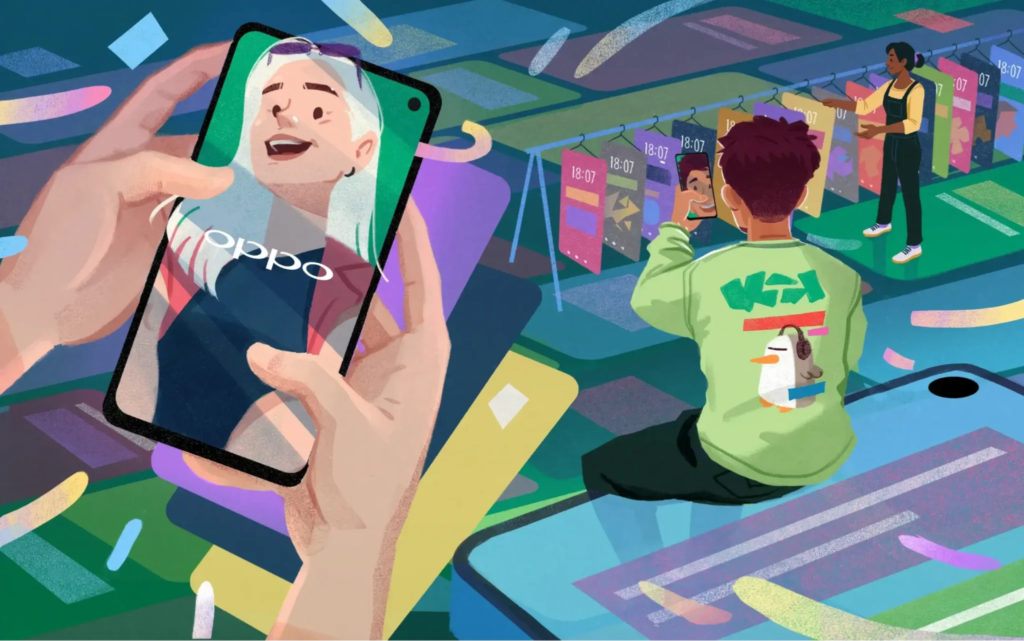
Brucira built a localized brand illustration system for OPPO India, applied consistently across the app store, browser, and theme store. The consistent visual language lifted both engagement and click-through rate across those touchpoints: a clear example of UI decisions translating directly into user behaviour, not just visual polish.
2. UX Design Focuses on the Journey Behind It
UX (user experience) design is concerned with how someone moves through a product to get something done, not just what it looks like along the way. A UX designer maps user flows, tests navigation, and removes friction between a person’s goal and the moment they reach it. Where UI asks “does this look right,” UX asks “does this work, and does it feel effortless.” That’s the core of the UI vs UX distinction: one shapes the surface, the other shapes the path.
3. UX Design Starts With Research, Not Screens
Good UX work rarely starts in a design tool. It starts with research: interviews, analytics, and usability testing that reveal where real users get stuck. Only once that friction is understood does a UX designer start sketching flows and wireframes. Skipping this step is how teams end up redesigning a product that looks better but still doesn’t convert, because the underlying friction was never diagnosed in the first place.
4. UI vs UX: Different Deliverables, Different Tools
The two roles produce different artefacts. A UI designer hands off style guides, component libraries, and high-fidelity mockups in tools like Figma. A UX designer hands off user journey maps, wireframes, sitemaps, and research findings. On a healthy team these feed into each other constantly: UX defines the structure, UI decides how that structure looks and feels, and neither is complete without the other.
How Brucira Shaped Powerplay‘s Brand Identity
Brucira designed the logo and brand identity for Powerplay, a construction management platform, giving the product a consistent visual language to carry across its dashboard, marketing, and collateral. It’s a reminder that UI consistency starts upstream of any single screen, with the identity system a UI designer then applies screen by screen.
5. Product Designers Blend UI, UX, and Testing Into One Role
A product designer usually owns both UI and UX for a feature or product area, plus the iteration that follows launch. That means running prototyping and testing cycles to see whether a design actually solves the problem before it ships widely, then adjusting based on what real usage shows. It’s less a separate discipline than a role that carries UI and UX thinking all the way through to a shipped, tested product, a natural fit for teams following a defined product design process.
6. Where Product Managers Fit In
A product manager vs UI UX designer roles comparison usually confuses people, because a PM doesn’t design screens or flows at all. Instead, a product manager decides what gets built and why: they own the roadmap, prioritise features against business goals, and represent the customer’s needs to engineering and design. UI and UX designers then decide how that decision gets built. A useful shorthand: PMs decide what and why, designers decide how.
7. UI Designer vs UX Designer vs Product Designer: Who Do You Actually Need?
If your product’s core flows already work well and you need visual polish, consistency, or a design system, hire a UI designer. If people are dropping off, confused, or churning despite the product technically working, you likely have a UX problem and need a UX designer to diagnose it through research. And if you need one person to own a feature end to end, from initial UX research through UI decisions to post-launch testing, a product designer is usually the better fit. Many small teams start with one product designer and specialise later.
Final Thoughts
UI, UX, product design, and product management aren’t competing job titles, they’re different lenses on the same problem: building something people actually want to use. Understanding the difference between UI and UX design, and where product design and product management fit around it, helps you staff a team correctly and avoid asking one role to solve a problem that belongs to another.
Have a UI, UX, or product design project in mind? Reach out to Brucira at hello@brucira.com. Browse more insights on the Brucira blog or see our work at brucira.com/work.
FAQs
Q1: What is the main difference between UI and UX design?
The difference between UI and UX design comes down to focus. UI (user interface) design shapes the visual and interactive elements a person sees, like buttons, colour, and typography, while UX (user experience) design shapes the underlying journey, research, and flow that gets someone to their goal. Put simply, ux vs ui design is the divide between how a product looks and how it works.
Q2: Is a product designer the same as a UI or UX designer?
Not exactly. A product designer typically combines UI and UX responsibilities into a single role, owning a feature from research through to shipped, tested screens. In a UI designer vs UX designer vs Product designer comparison, the product designer is the generalist who carries a feature the whole way through, while UI and UX designers often specialise in one half of that process.
Q3: How does a product manager’s role differ from a UI/UX designer’s?
In a product manager vs UI UX designer roles comparison, the biggest difference is ownership. A product manager decides what gets built and why, based on business goals and customer needs, while UI and UX designers decide how it gets built and used. The two roles work closely together, but a PM rarely touches the actual interface or user flow directly.
Q4: Do I need both a UI designer and a UX designer on my team?
It depends on your product’s stage. Early-stage teams often hire one product designer to cover UI vs UX design needs together, since research and visual design decisions are still tightly linked. As a product scales, splitting into dedicated UI and UX roles usually makes sense, since each side of the work gets deep enough to need a specialist.
Q5: How can I tell if my product has a UI problem or a UX problem?
If users understand how to use your product and still don’t like how it looks or feels, that’s usually a UI issue. If users get confused, drop off, or can’t complete a task even though the visuals are polished, that’s a UX issue rooted in flow or structure, not appearance. Usability testing and analytics are the fastest way to tell them apart.
Still not sure whether your product needs UI work, UX work, or both? Get in touch with Brucira.