





Every high growth SaaS startup eventually outgrows its own product. Once the interface that shipped in year one starts fighting the roadmap in year three, ad hoc tweaks stop working. What you need is a real product redesign strategy for high growth startups, one that treats research, feature prioritization and migration as a single connected system, not three separate scrambles.
1. Diagnose Why the Redesign Is Necessary
Before anyone opens Figma, get specific about the problem. Rising churn, a spike in support tickets, a stalled activation rate, or engineers quietly avoiding a legacy module are all signals worth naming out loud. If you are unsure whether you are looking at a cosmetic refresh or a structural rebuild, this rundown of warning signs that you need website redesign services is a useful gut check before you commit budget.
2. Run Structured Redesign Research
Redesign research is where most SaaS product redesign projects quietly succeed or fail. Pull usage analytics, replay onboarding sessions, tag support tickets by theme, and interview both power users and people who churned. Add a quick competitive teardown so you know which patterns your market already expects. The goal is a ranked list of validated problems, not a wishlist, feeding directly into the product design process you follow next.
3. How to Write a Creative Brief for Product Redesign
A tight creative brief turns research into direction. It should state the core problem in one sentence, name the primary user and their job to be done, list the metrics that define success, and flag any must-keep features or constraints. This is also where you commit to the brand strategy and positioning the redesign needs to reinforce, rather than bolting it on at launch.
How Brucira Sharpened the Value Proposition for FunnelStory
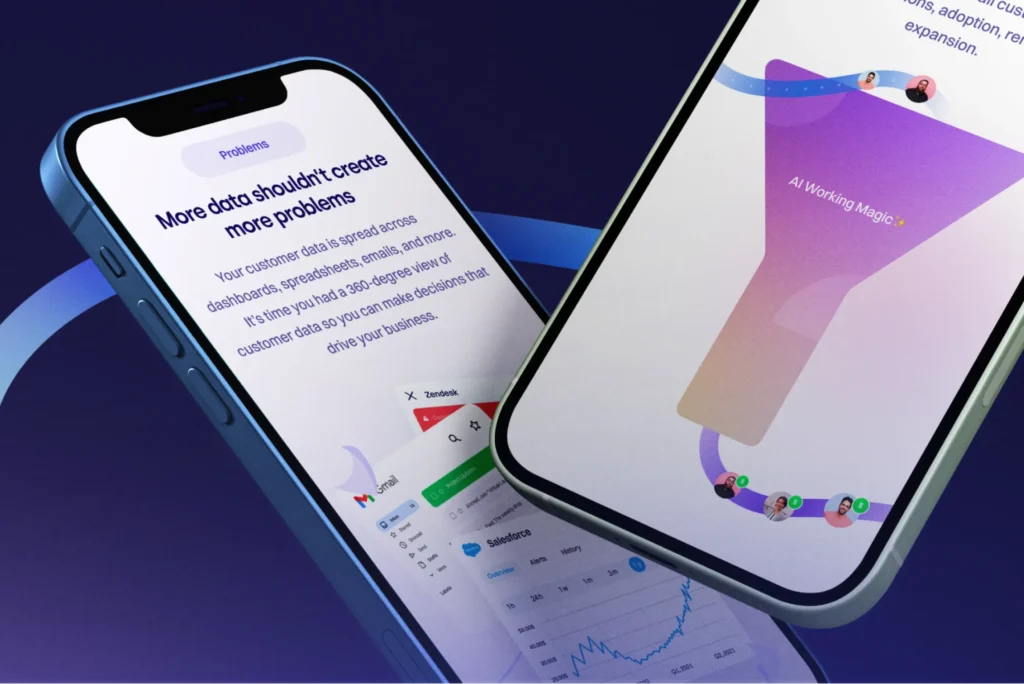
FunnelStory, a B2B sales visibility platform, came to Brucira with a strong product and a website that failed to explain it. The redesign started with a brief that pinned down exactly how FunnelStory needed to be understood by go-to-market leaders, then carried that positioning through a full web and mobile redesign with custom illustration and iconography.
The result was a cleaner, more user-centric experience matching the sophistication of the product itself, a reminder that a creative brief keeps every later design decision pointed at the same problem.
4. Set Success Metrics and Guardrails Before You Design
Agree on a north star metric (activation, retention, expansion revenue) and a short list of guardrail metrics that should not regress, such as page load time or support ticket volume. Write these down before design work starts so that feature debates later have an objective tiebreaker instead of the loudest opinion in the room. This step is what separates a real product redesign strategy for high growth startups from a redesign driven by whoever pitches the loudest.
5. Prioritize Features With a Repeatable Framework
Feature prioritization is where research turns into a shippable plan. Score each candidate feature with a simple framework like RICE or MoSCoW, weighing reach and impact against effort. Resist the urge to rebuild everything at once. Sequence the backlog into phases so the highest confidence, highest impact work ships first and validates the direction before you invest further.
How Brucira Prioritized Features for Housing’s Developer Panel
Housing needed a web-based admin panel letting property developers manage leads inside a complex, AI-powered platform without breaking the underlying architecture. Brucira ran structured user research with the developers who would actually use the panel daily, then used those findings to prioritize which dashboard capabilities mattered most.
The prioritized panel now helps developers manage both organic and reclaimed leads from one screen, supporting a platform processing thousands of listings a day, proof that disciplined feature prioritization, not a longer feature list, is what makes a redesigned product actually get used.
6. Prototype and Test Before You Commit
Turn the prioritized backlog into clickable prototypes before committing engineering time. Run prototyping and iterative testing sessions on the highest risk flows first, whether that’s onboarding, checkout, or a core workflow screen. Cheap changes here save expensive rework later.
7. Build a Product Migration Strategy
A product migration strategy protects the data and habits existing users already rely on. Map every data field, permission and integration from the old system to the new one, build a feature parity checklist so nothing important quietly disappears, and use feature flags to roll the new experience out to a small cohort first.
8. Roll Out in Phases and Communicate the Change
Launch to a beta group first, gather feedback, then expand. Pair the rollout with in-app messaging, a clear changelog, and a support team briefed on what changed and why. Keep a rollback plan ready in case the migration surfaces an issue testing missed.
9. Measure, Iterate and Close the Loop
Once the redesign is live, measure it against the metrics and guardrails from step four, not just anecdotal feedback. Keep a visible feedback channel open and treat the launch as the start of the next research cycle, not the finish line.
Final Thoughts
A product redesign strategy for high growth startups only works when research, feature prioritization and migration are planned together, not handled as separate handoffs. Get the sequence right and the redesign strengthens the product, not just how it looks.
Have a SaaS redesign project in mind? Reach out to Brucira at hello@brucira.com. For more guides like this one, visit the Brucira blog, and see more of our work at brucira.com/work.
FAQs
Q1: What is a product redesign strategy for high growth startups?
It is a structured plan that connects research, feature prioritization and migration so a fast-growing SaaS product can change without breaking what already works. Rather than jumping straight to visuals, the strategy starts with why the redesign is needed and ends with a measured, phased rollout.
Q2: How do you conduct redesign research before a SaaS product redesign?
Combine quantitative signals like analytics and support ticket themes with qualitative input from user interviews and session recordings. Good redesign research produces a ranked list of validated problems, not a list of features someone liked on a competitor’s app.
Q3: How do you prioritize features during a product redesign?
Score candidate features against reach, impact, effort and confidence using a framework like RICE or MoSCoW, then sequence them into phases instead of trying to ship everything at once. Feature prioritization keeps the redesign scoped to what will actually move the metrics you defined upfront.
Q4: How do you write a creative brief for a product redesign?
State the core problem in one sentence, name the primary user and their goal, list the metrics that define success, flag any must-keep features or constraints, and confirm the positioning the redesign needs to reinforce. A clear brief keeps design, engineering and stakeholders aligned on the same problem throughout the project.
Q5: What is a safe product migration strategy for a SaaS redesign?
Map every data field, permission and integration from the old system to the new one, build a feature parity checklist, and roll out to a small beta cohort using feature flags before a full switch. Keep a rollback plan ready so a migration issue never turns into a full outage.
Have more questions about planning a redesign the right way? Get in touch with Brucira.